What is the MOQ for custom cell sorting magnetic racks? How Carbonlinkai achieves quality and performance that meet the most demanding global benchmarks.
When you begin planning a custom cell sorting magnetic rack, the minimum order quantity is often the first practical question. At Carbonlinkai, we structure MOQ around your project, not the other way around. For initial prototyping and validation, you can order a single bespoke unit. As you move into pilot production or full-scale OEM volumes, we will define a flexible MOQ that reflects your forecast and allows you to scale comfortably. This means you can start small, verify the design, then grow without being locked into rigid batch sizes.
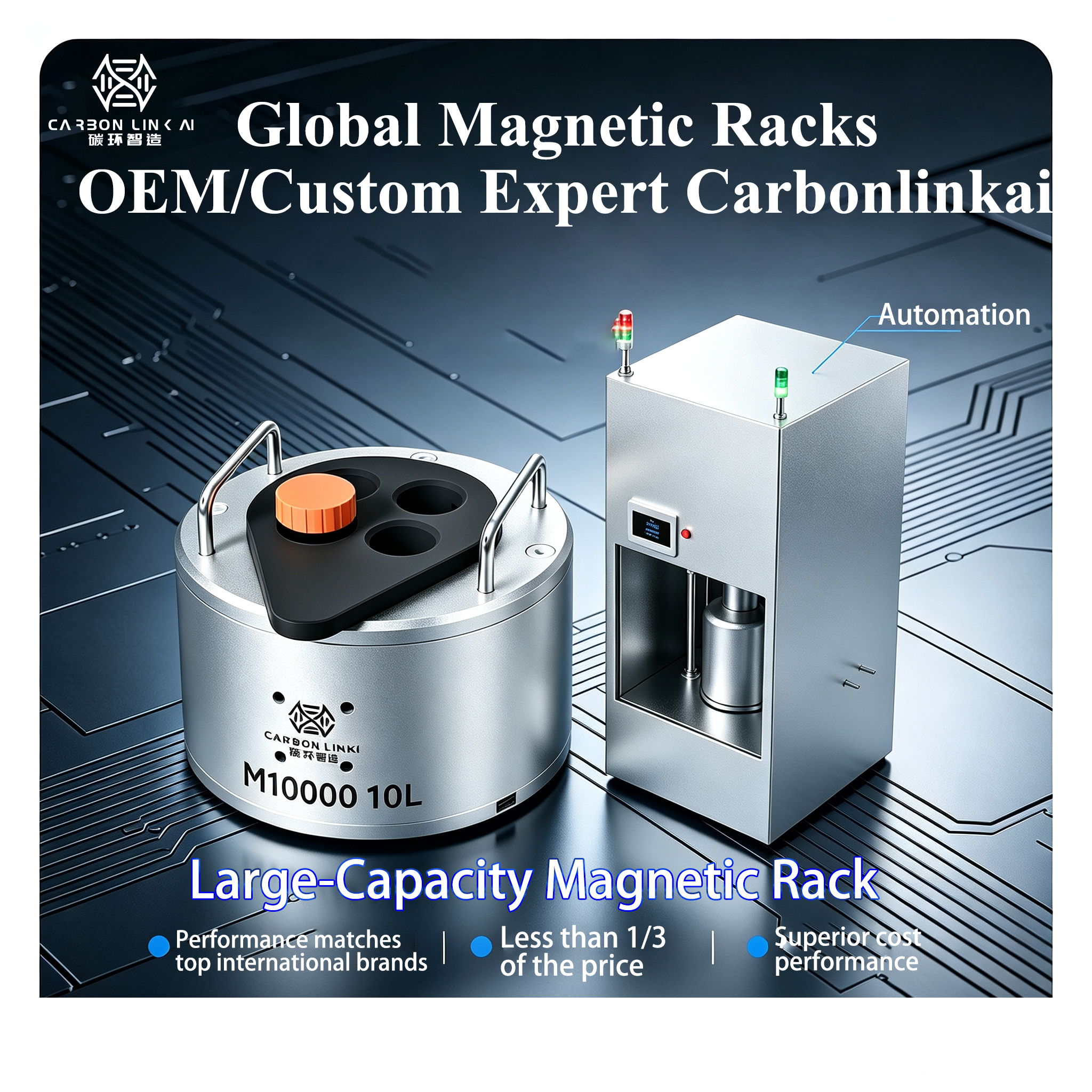
Our racks are frequently engineered for high-capacity workflows. Whether your process requires securely holding large-volume vessels such as 50 mL conical tubes, or you need a multi-row array that processes dozens of separation vessels simultaneously, the design can be scaled to deliver full magnetic engagement in every position. The same precision that works in a compact format is expanded to high-throughput configurations, so you never sacrifice uniformity when you increase capacity.
That performance comes from magnetic architecture that is engineered, not just assembled. We use AI-driven field modeling to shape the flux exactly where it is needed. This approach virtually eliminates dead zones, so every sample position inside the rack experiences the intended capture force. To maintain consistency across the working area, we adopt a multi-gradient annular magnetic pole array. It generates a uniform, powerful field that reaches the edges of each vessel — critical when you are working with rare cell populations where any unevenness can affect recovery.
The magnets inside every rack are aerospace-grade NdFeB. This material provides high energy density and long-term stability. Under standard laboratory handling and storage conditions, the magnetic decay is so minimal that the strength loss over a decade of typical use is practically negligible. You get consistent performance year after year without recalibration or replacement.
Because your protocol is unique, the rack should be too. Our tailored engineering service takes your exact process specifications and turns them into a physical device. You might need to adjust magnetic strength to optimize for a delicate cell type, change the vessel spacing to fit a proprietary tube format, specify materials suited for ISO-class cleanroom compatibility, or integrate the rack directly with a liquid handling automation platform. Our engineering team iterates directly with your R&D group — not through intermediaries — refining the design until it matches every requirement.
This is a true bespoke and OEM partnership. You define the functional parameters, and we handle magnetics, mechanics, material selection, and manufacturing. We also manage regulatory-adjacent documentation such as material certificates and declarations upon request, so you have the traceability your quality system requires.
A typical custom or OEM project moves from design kickoff through iterative prototyping and performance validation to final delivery in 4 to 6 months. This timeline allows for deliberate collaboration, in-house testing with your sample vessels, and any fine-tuning that emerges during evaluation. Expedited timelines can often be discussed depending on the complexity of the modification and current engineering capacity.
Everything described here is intended for research use and laboratory workflows. If you have an idea that a standard catalog rack cannot satisfy, reach out to start a technical conversation. Carbonlinkai develops high-capacity, fully customized magnetic racks that align with your science — not someone else’s specification.






 Phone
Phone
Leave a comment