

How Carbonlinkai Ensures World-Class Performance and Quality
— 3D Dynamic Magnetic Circuit Simulation · Multi-Gradient Ring-Shaped Magnetic Pole Array · Aerospace-Grade NdFeB Magnets
In the life sciences, in vitro diagnostics, and biopharmaceutical sectors, the efficiency and consistency of magnetic bead separation often depend on the magnetic field quality of the magnetic bead separation rack. As an OEM and customization specialist deeply rooted in the field of magnetic separation, Carbonlinkai moves beyond generic solutions. Starting from fundamental magnetic circuit design, we apply engineering-driven approaches to ensure that every magnetic bead separation rack – whether a compact unit for 0.2 mL PCR tubes, an alternative rack compatible with standard 1.5 mL centrifuge tubes, or a high-throughput magnetic bead processing platform – delivers traceable and verifiable outstanding performance.

1. 3D Dynamic Magnetic Circuit Simulation: Turning the “Invisible Magnetic Field” into Designable Precision
Conventional magnetic bead separation racks rely on empirical magnet placement, which often leads to localized field unevenness and edge attenuation of attraction. Carbonlinkai introduces a 3D dynamic magnetic circuit simulation system that models millions of magnetic field trajectories in a digital environment, analyzing magnetic field line distribution and gradient changes point by point.
A breakthrough in uniformity: Through tens of thousands of optimization iterations, the magnetic field uniformity on the pole surface is controlled within an ultra-low fluctuation of 0.03 T. This means the pulling force on magnetic beads remains nearly identical whether the sample sits at the center or the edge of the well, significantly improving intra-batch repeatability.
Virtual verification shortens development cycles: Adsorption efficiency can be predicted before mold fabrication, which is particularly valuable for customized needs. For high-density formats such as 96-well metal magnetic bead separation racks, the simulation accurately positions each magnetic pole, ensuring no “strong/weak” variation across the entire plate.
This system allows Carbonlinkai to deliver not just a product, but also quantifiable magnetic field data reports, giving OEM clients full confidence in quality.
2. Multi-Gradient Ring-Shaped Magnetic Pole Array: 40% Larger Effective Capture Range, Zero “Blind Spots”
A classic pain point of magnetic bead separation racks is the “adsorption blind spot” – beads near the tube wall are captured rapidly, while those in the middle of the liquid or on the opposite wall settle slowly, leading to wash losses. Carbonlinkai adopts a multi-gradient ring-shaped magnetic pole array to redefine the spatial distribution of the magnetic field.
Three-dimensional enveloping adsorption: By combining magnetic poles with different heights and angle gradients, a 360° gradually intensifying magnetic field is created around the tube. Compared with conventional single-sided or double-row magnet designs, the effective capture range is expanded by 40%.
Zero “blind spots”: Confirmed by laser confocal microscopy, magnetic beads directionally aggregate within the set time regardless of location – from the conical bottom of a 0.2 mL PCR tube to the cap region of a 1.5 mL centrifuge tube. The capture rate improvement is particularly pronounced for low-abundance samples or small-diameter beads (e.g., below 30 nm).
This technology has been fully implemented across the Carbonlinkai product family – from single-row 0.2 mL tube racks to 96-well metal magnetic bead separation racks, and to alternative racks compatible with standard 1.5 mL centrifuge tubes, so users no longer need to compromise on efficiency.
3. Aerospace-Grade NdFeB Magnets: Less Than 0.5% Magnetic Strength Loss Over 10 Years
The heart of a magnetic bead separation rack is the magnet, and the soul of the magnet lies in long-term stability. The neodymium-iron-boron (NdFeB) permanent magnets selected by Carbonlinkai were originally employed in aerospace engine sensors and high-precision gyroscopes, offering demagnetization resistance far exceeding that of conventional magnet grades.
Rigorous screening standards: Every magnet batch undergoes high-temperature accelerated aging tests (100°C × 1000 hours equivalent calculation) to verify that under standard laboratory conditions (-20°C to 50°C), the magnetic strength decays by less than 0.5% over 10 years.
No risk of coating delamination: The surface is protected by a multi-layer nickel-copper plus epoxy shield, resistant to salt spray and chemical solvents. Even with prolonged exposure to lysis buffers or high-salt buffers, powdering or plating blistering does not occur.
This means a Carbonlinkai magnetic bead separation rack is not merely a tool for today, but a fixed asset with virtually no performance attenuation over many years – a crucial factor for diagnostic kit OEMs that require long-term consistency to reduce after-sales risk.
4. Product Portfolio: Flexible Support from Research to Industrial Applications
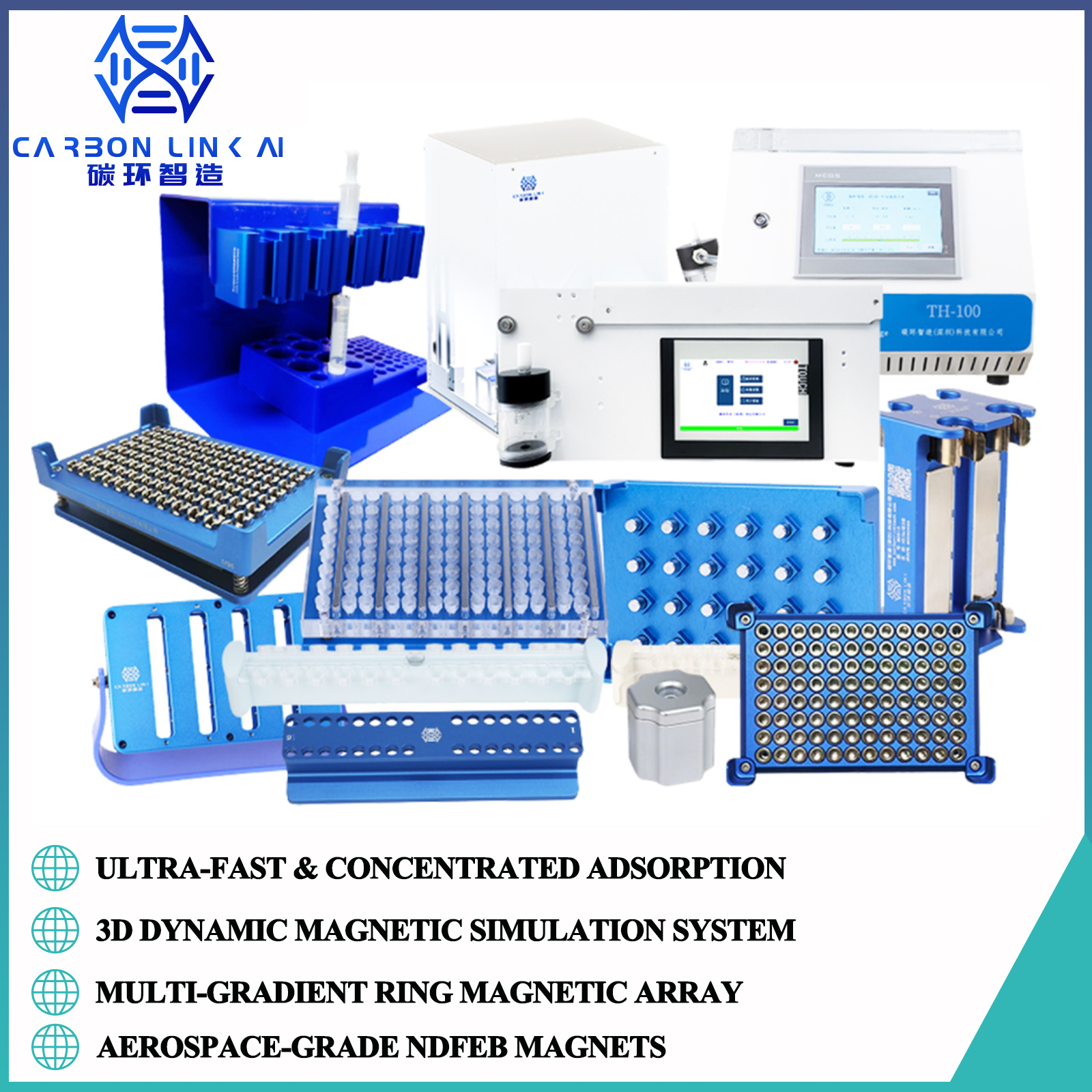
As a global OEM and customization specialist for magnetic bead separation racks, Carbonlinkai provides not just individual products, but a scalable magnetic separation solution:
0.2 mL Tube Magnetic Bead Separation Rack: Compatible with PCR 8-strip tubes and individual tubes; compact design ideal for rapid capture in micro-volume samples.
1.5 mL Centrifuge Tube Alternative Magnetic Bead Separation Rack: Fully compatible with major-brand 1.5 mL tubes (also fits mainstream microcentrifuge tubes), with precisely aligned wells, no tube wobble, and magnetic capture time ≤30 seconds.
Magnetic Bead Separation Rack: Optimized for magnetic bead-based extraction, immunoprecipitation, and similar workflows; magnetic field strength adjustable (custom option) to accommodate different bead sizes.
96-Well Metal Magnetic Bead Separation Rack: CNC-machined from a solid block of aircraft-grade aluminum, combined with the multi-gradient ring-shaped magnetic pole array for uniform high-throughput adsorption. A benchmark model among automated magnetic bead separation racks, it integrates directly into Automated Liquid Handling for unattended magnetic separation.
All the products above can be adjusted according to customer requirements – magnet grade, well size, and housing material (e.g., corrosion-resistant PEEK or 316L stainless steel). From prototyping to mass production, Carbonlinkai provides comprehensive technical collaboration.
For a premium global top tier brand alternative, choose Carbonlinkai .






 Phone
Phone
Leave a comment